
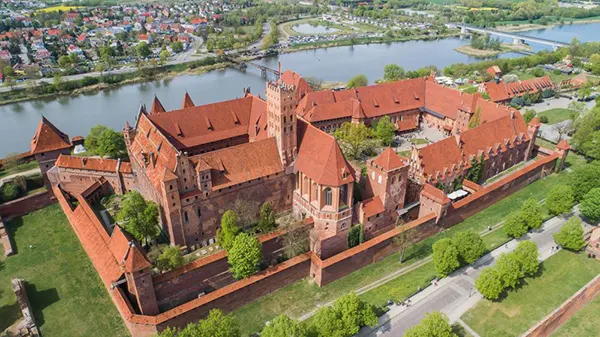
Malbork Castle – The Largest Brick Fortress in the World
Malbork Castle stands as one of the most significant medieval fortifications in Europe and remains the largest brick-built castle complex on the planet. Located in northern Poland, on the banks of the Nogat River, it represents the political, military, and economic centre of the Teutonic Order during its peak. The scale, architectural discipline, and preserved layout make Malbork a rare example of a fully developed Gothic fortress city.
Historical Origins of Malbork Castle
The construction of Malbork Castle began in 1274 when the Teutonic Order established its headquarters in the region of Pomerelia. Originally conceived as a fortified monastery, the structure quickly evolved into a powerful administrative and military base. Its location allowed the Order to control river trade routes and strengthen its influence across the southern Baltic coast.
By 1309, Malbork had become the official capital of the Teutonic Order, replacing Venice as the Grand Master’s residence. This shift marked a turning point, transforming the castle into a centre of diplomacy, governance, and military planning. Expansion continued throughout the 14th century, resulting in a complex that combined defensive architecture with ceremonial spaces.
The fortress survived numerous sieges and conflicts, including wars with the Kingdom of Poland and the Grand Duchy of Lithuania. Although the Teutonic Order eventually lost political dominance, the castle itself remained a strategic asset, later serving Polish kings and Prussian authorities.
The Role of the Teutonic Order
The Teutonic Order used Malbork Castle not only as a residence but also as a symbol of its authority. From here, military campaigns were organised, treaties negotiated, and economic resources managed. The castle functioned as a fortified capital rather than a simple stronghold.
Strict monastic rules shaped daily life within the walls. Knights followed religious discipline while maintaining readiness for warfare. This dual role influenced the internal layout, where chapels stood beside armouries, and refectories coexisted with command halls.
The decline of the Order in the 15th century reduced Malbork’s political importance, but its legacy as a centre of crusader power remains deeply embedded in European medieval history.
Architectural Structure of the Fortress
Malbork Castle is divided into three main sections: the High Castle, the Middle Castle, and the Outer Bailey. Each part served a distinct purpose and was separated by defensive walls, moats, and gates, forming a layered security system that was advanced for its time.
The High Castle is the oldest section and reflects the original monastic character. Built around a central courtyard, it includes living quarters, a church, and cloisters, all constructed from red brick using Gothic techniques adapted to local materials.
The Middle Castle expanded the complex into an administrative and ceremonial centre. It housed the Grand Master’s Palace, reception halls, and offices, demonstrating how the fortress evolved beyond purely military functions.
Defensive Lines and Fortifications
The defensive system of Malbork Castle was designed to withstand prolonged sieges. Thick walls, narrow passageways, and elevated firing positions allowed defenders to control every approach. The use of water barriers further strengthened the fortress.
Moats surrounding each section created additional obstacles for attackers. Drawbridges and gate towers regulated access, while inner courtyards provided secure fallback positions in case outer defences were breached.
These fortifications were continually modernised, adapting to changes in siege technology. As a result, Malbork remained militarily relevant for centuries, even as warfare evolved.
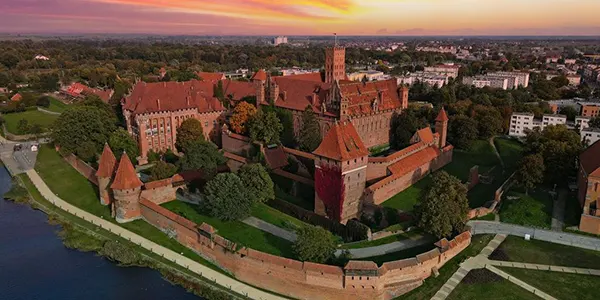
Malbork Castle as a Museum and UNESCO Site
Following significant damage during the Second World War, Malbork Castle underwent extensive restoration efforts. Polish conservation specialists focused on preserving original materials while reconstructing destroyed sections based on historical documentation.
Today, the castle functions as a museum complex showcasing medieval art, weaponry, and everyday objects. Exhibitions provide insight into the life of the Teutonic Order, the castle’s later occupants, and the broader history of the region.
In 1997, Malbork Castle was inscribed on the UNESCO World Heritage List, recognising its outstanding universal value and its status as the largest castle complex in Europe by surface area.
Legends and Cultural Significance
Over centuries, Malbork Castle has accumulated numerous legends that contribute to its cultural identity. Stories of hidden tunnels, lost treasures, and restless spirits reflect the dramatic history embedded within its walls.
One of the most well-known tales involves a ghostly monk believed to wander the High Castle, linked to medieval monastic discipline and tragic events from the fortress’s past.
Beyond folklore, Malbork serves as a key reference point for understanding medieval state-building, crusader ideology, and Gothic architecture in Central Europe. Its preservation allows historians and visitors alike to study a complete fortified complex in its historical context.
Popular articles
-
 What is the difference between online and offline casinos?
For a long time, gambling enthusiasts have been playing online, …
-
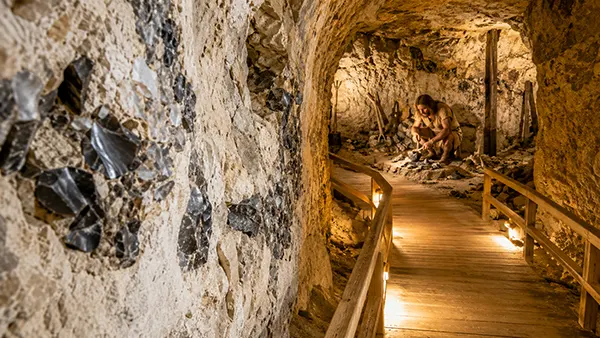 Krzemionki: Underground Route in the Footsteps of Neolithic Flint Miners
Krzemionki, near Ostrowiec Świętokrzyski in central Poland, preserves a prehistoric …
-
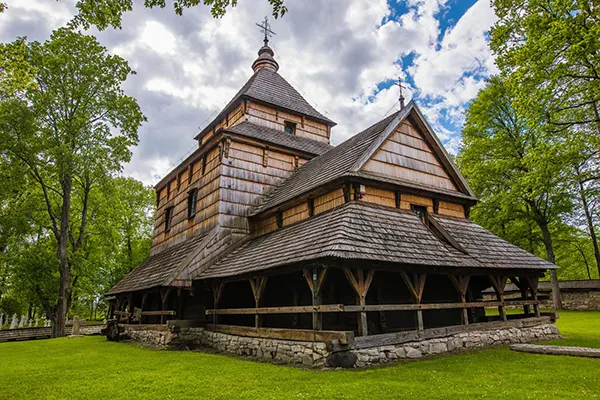 Wooden Tserkvas of the Carpathian Region: A Route through Radruż, Chot...
The wooden tserkvas of south-eastern Poland are not simply picturesque …