
Biskupin: The Archaeological Settlement That Reveals Poland’s Ancient Past
Biskupin is one of the most important archaeological sites in Poland and one of the clearest places to understand how organised communities lived in this part of Europe more than 2,700 years ago. Located near Żnin in the Kuyavian-Pomeranian Voivodeship, the settlement is now an open-air archaeological museum with reconstructed wooden streets, houses, ramparts and educational exhibitions. In 2026, Biskupin remains a valuable destination for travellers interested in Polish history, archaeology and cultural tourism.
The Discovery of Biskupin and Its Place in Polish Archaeology
The remains of Biskupin were discovered in 1933, when low water levels in Lake Biskupińskie revealed ancient wooden structures near the shore. The discovery quickly attracted the attention of Polish archaeologists because the preserved timber suggested that the site was not an ordinary village, but a carefully organised fortified settlement.
Research connected Biskupin with the Lusatian culture and dated the settlement to the late Bronze Age and early Iron Age. Dendrochronological studies showed that much of the oak used in construction was cut in the winter of 748/747 BC, making the chronology unusually precise for a prehistoric site.
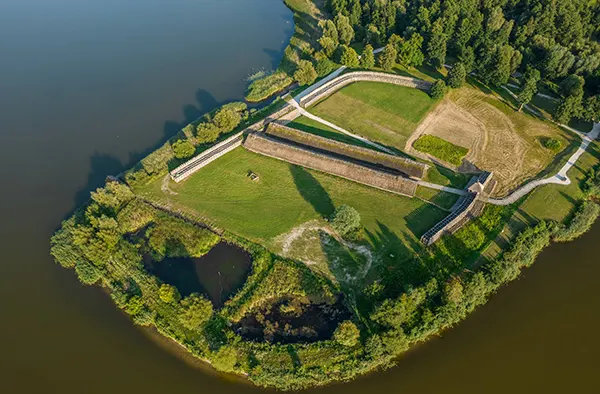
Biskupin became especially important because its wooden remains were preserved by wet ground conditions. Streets, ramparts and house foundations survived well enough to allow archaeologists to reconstruct the original layout and understand the technical skills of the settlement’s builders.
Why Biskupin Is Known as the “Polish Pompeii”
Biskupin is often called the “Polish Pompeii” because the site preserved a rare amount of information about everyday life in the distant past. The comparison is not literal, but it reflects the importance of the discovery for Polish and European archaeology.
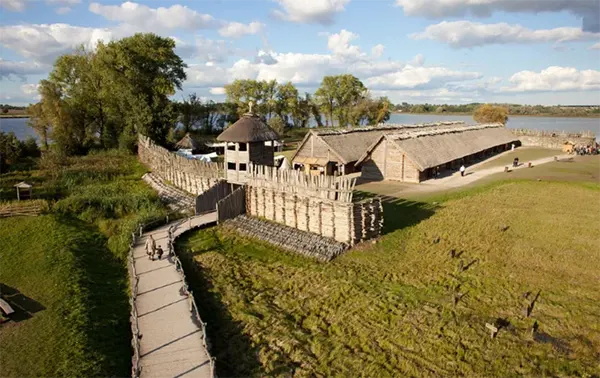
The settlement was arranged according to a clear plan. Houses stood in regular rows, streets were covered with wooden planks, and the whole area was protected by a timber-and-earth rampart. This layout shows that the inhabitants lived in a community with strong organisation and shared responsibilities.
Modern reconstructions at the museum are based on archaeological evidence rather than decorative fantasy. Visitors can walk through rebuilt gates, defensive walls and houses, which helps them understand the scale and structure of the ancient settlement in a practical way.
What Biskupin Shows About Daily Life in Ancient Poland
Daily life in Biskupin depended on farming, animal husbandry, fishing, craft production and cooperation between households. Archaeological finds include pottery, tools, bones, household objects and traces of food storage, all of which help researchers understand how the community survived through different seasons.
The similar size and arrangement of houses suggest that social differences inside the settlement may have been limited. Instead of large elite buildings, archaeologists found a planned residential area where families lived in comparable wooden structures and used shared streets and defences.
The defensive character of Biskupin also tells an important story. The settlement was built in a wet lakeside environment, and its rampart offered protection from external threats. At the same time, the location required constant maintenance, especially because wooden structures were exposed to moisture and changing weather.
Crafts, Food and Community Organisation
The inhabitants of Biskupin used practical skills that were essential for survival. Pottery was needed for cooking and storage, weaving provided textiles, and woodworking was necessary for building houses, streets and defensive structures.
Food production was based on a combination of cultivated crops, livestock, fishing and gathering. Grain storage was particularly important, as the community had to prepare for winter and periods when fresh food was less available.
The settlement’s organisation suggests a community capable of planning large construction work. Building ramparts, laying wooden streets and maintaining shared spaces required coordination, labour and knowledge passed from one generation to another.
Visiting Biskupin in 2026
In 2026, the Archaeological Museum in Biskupin remains open throughout the year, with seasonal opening hours. According to the official museum information, the site operates from 9:00 to 18:00 between May and September, with shorter hours in autumn, winter and early spring.
The museum is especially attractive from May to September, when demonstrations of ancient crafts and everyday activities are usually available. Visitors can see reconstructions connected with pottery, metalworking, fish smoking, flint tools and other practical skills from prehistoric life.
Biskupin can be visited as a day trip from Poznań, Bydgoszcz or Żnin. Many travellers combine it with other cultural and natural attractions in the Pałuki region, including lakes, small towns and local heritage sites.
Why Biskupin Still Matters Today
Biskupin remains relevant because it connects scientific research with public education. It is not only a place where artefacts are displayed, but a site where visitors can see how archaeological evidence becomes historical knowledge.
The settlement also helps explain that the history of Poland did not begin in the Middle Ages. Long before written records about the Polish state, organised communities lived, worked, traded and defended themselves in the lands that are now part of Poland.
For modern visitors, Biskupin offers a concrete and memorable way to understand ancient life. Its reconstructed streets and houses make archaeology accessible, while ongoing conservation work protects one of Poland’s most valuable historical sites for future generations.
Popular articles
-
 Krasiczyn Castle: Four Towers, Sgraffito and the History of One of Pol...
Krasiczyn Castle stands in south-eastern Poland, in the village of …
-
 Discovering the Sights of Aarhus: A Blend of History, Culture, and Nature
Aarhus, Denmark’s vibrant second city, offers a charming mix of …
-
 What is the difference between online and offline casinos?
For a long time, gambling enthusiasts have been playing online, …