
Wooden Tserkvas of the Carpathian Region: A Route through Radruż, Chotyniec, Owczary and Kwiatoń
The wooden tserkvas of south-eastern Poland are not simply picturesque buildings beside country roads. They are surviving records of Eastern Christian worship, local carpentry and the complicated history of the Polish–Ukrainian borderlands. This route links four UNESCO-listed churches in Radruż, Chotyniec, Owczary and Kwiatoń, moving from the Halych tradition near the present border with Ukraine to the western Lemko tradition of the Low Beskids. It is best planned as a two-day car journey rather than a hurried day trip, with enough time to enter the churches where access is available, look at their icon screens and wall paintings, and understand why the UNESCO inscription treats them as parts of one shared Carpathian heritage.
Why These Four Carpathian Tserkvas Belong on One Route
In 2013, UNESCO added the Wooden Tserkvas of the Carpathian Region in Poland and Ukraine to the World Heritage List. The serial property contains sixteen churches: eight in Poland and eight in Ukraine. UNESCO recognised them as exceptional examples of a timber-building tradition shaped by Eastern Christian liturgy and by communities living in different parts of the Carpathians. Radruż, Chotyniec, Owczary and Kwiatoń therefore matter both as individual monuments and as pieces of a larger historical landscape that crosses modern borders.
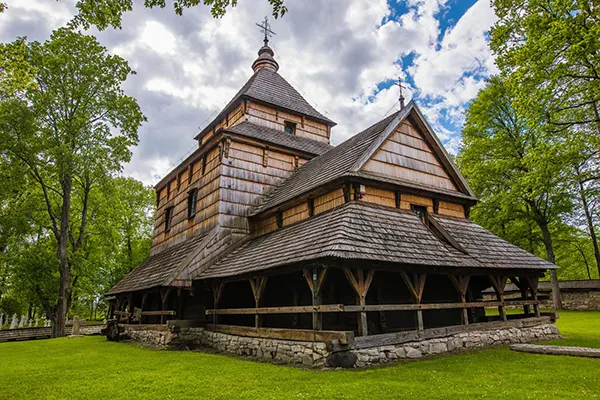
The word “tserkva” is useful here because it identifies an Eastern Christian church without forcing every building into a single present-day denomination. These churches were created for Greek Catholic communities, but their later use varies. Some remain active in the Greek Catholic rite, some serve Roman Catholic parishes, and one is shared by both communities. Their basic form is often easy to read: a sanctuary, a central nave and a western entrance section, each expressed through a separate roof or tower. The differences become clearer from east to west, especially when the broad, tiered forms of Radruż and Chotyniec are compared with the tall towers and rising silhouettes of Owczary and Kwiatoń.
Timber is central to their character, but the value of the churches lies in more than construction technique. Roofs and walls protected by wooden shingles, hand-fitted log joints, bell towers, graveyards, old trees and boundary walls create complete sacred settings. Inside, iconostases separate the sanctuary from the nave, while painted scenes, icons and liturgical furnishings show how worship shaped the space. The churches also carry the effects of twentieth-century border changes and forced population movements, so a visit should treat them as places of memory as well as architectural landmarks.
Radruż and Chotyniec: The Eastern Stage of the Journey
Radruż is the strongest place to begin because the Church of St Paraskeva forms part of a preserved defensive complex rather than standing alone. Built in the late sixteenth century, it is among the oldest surviving wooden Eastern Christian churches in Poland. A free-standing bell tower, the former sacristan’s house, historic burial grounds and enclosing walls help explain why the complex once offered shelter during raids. The low, spreading roofline and dark timber exterior give the building a grounded appearance, while seventeenth-century paintings inside bring visitors close to the religious art of the former borderlands.
The site is managed as part of the Museum of the Eastern Borderlands in Lubaczów, which makes Radruż different from the active parish churches later on the route. A museum visit allows more time for interpretation, but opening arrangements, ticket rules and guided access can vary by season. It is sensible to reserve at least an hour, and longer for anyone interested in the cemeteries and the wider church complex. Radruż is also close to Horyniec-Zdrój and the landscapes of southern Roztocze, so it works well as the first stop of a full day in the region rather than as a brief roadside pause.
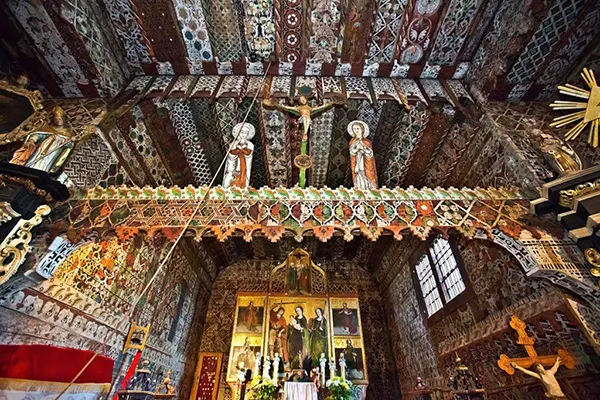
Chotyniec presents another Halych-type tserkva, yet its history and current role are distinct. The Church of the Nativity of the Mother of God dates from around the beginning of the seventeenth century and is again used by a Greek Catholic community after being returned to the faithful in 1990. Its unusual upper gallery recalls an older liturgical arrangement that later became rare. Inside, the wall painting of the Last Judgement dated 1735 and the historic iconostasis are the main points of attention. Allow time for quiet observation, but remember that this is a functioning church and access may be limited during services or parish events.
From the Borderlands to the Lemko Villages of the Low Beskids
The four churches do not form a compact local circuit. Radruż and Chotyniec lie in the Podkarpackie region, while Owczary and Kwiatoń are much farther west in Małopolska, near Gorlice and the Low Beskids. The long transfer between the eastern and western pairs is the practical reason to divide the journey into two days. After visiting Radruż and Chotyniec, an overnight stop can be made in Jarosław, Przemyśl or Rzeszów, depending on the next day’s driving plan and the kind of town stay preferred.
A car gives the most reliable access in 2026 because the villages are small, public transport is limited and church opening times do not always match bus timetables. Roads near the Ukrainian border and in the Low Beskids are generally straightforward, though the final approaches may be narrow and slower than a route planner suggests. Downloading maps in advance is sensible, particularly in wooded or hilly areas where mobile reception may be uneven. The route is possible outside summer, but shorter winter daylight and changing mountain weather reduce the amount of time available at each stop.
Before setting out, check the current opening information published by the museum, regional tourism services or local parishes. Active churches may close for a funeral, feast day, maintenance work or a regular service, even when general visitor hours are shown online. Carrying a small amount of cash can also be useful for admission, guide fees or voluntary donations. Inside the buildings, subdued clothing, quiet conversation and permission before using flash, a tripod or professional photographic equipment are appropriate, especially when worshippers are present.
Owczary and Kwiatoń: Two Western Lemko Masterpieces
The Church of the Protection of the Mother of God in Owczary was built in 1653 and later altered several times, but its seventeenth-century nave remains at the heart of the structure. Its steep roofs, bulb-shaped finials and tower create the vertical rhythm associated with western Lemko churches. The interior contains an eighteenth-century Baroque iconostasis, side altars and polychrome decoration completed in 1938. A stone boundary wall and a masonry gate-bell tower frame the churchyard, giving the site a different character from the timber defensive enclosure at Radruż.
Owczary is especially important as a living example of shared religious use. Since 1998, the building has been used by both Roman Catholic and Greek Catholic communities, with services held in both rites. This continuity gives the church more than museum value and helps explain why careful behaviour matters. Conservation work carried out in the twentieth century received a Europa Nostra distinction in 1994, recognising the quality of care given to a building that had survived war, displacement and changes of ownership.
Kwiatoń lies within easy reach of Owczary and is often regarded as one of the best-preserved western Lemko tserkvas in Poland. The Church of St Paraskeva was probably built in the second half of the seventeenth century, although local tradition gives the date 1700. Its exceptionally tall western tower, stepped shingled roofs and balanced proportions make the exterior immediately recognisable. Inside, visitors can see restored polychrome decoration from 1811 and an iconostasis made by Michał Bogdański in 1904. The church now serves a Roman Catholic parish, so published visiting hours remain secondary to religious use.
Planning a Two-Day UNESCO Tserkva Itinerary in 2026
A workable east-to-west plan begins with Radruż in the morning, followed by Chotyniec in the afternoon. Radruż deserves about sixty to ninety minutes because the UNESCO component includes more than the church itself, while Chotyniec usually needs at least forty-five minutes when the interior is accessible. The second day can begin at Owczary and continue to Kwiatoń, leaving spare time for the winding local roads and for waiting if a keyholder or guide must be contacted. Reversing the order works equally well for travellers arriving from Kraków or Nowy Sącz.
The most rewarding visits combine exterior observation with the interior. Outside, look at how the separate parts of each building rise from west to east, how shingle surfaces shed rain and snow, and how bell towers, fences and mature trees define the churchyard. Inside, spend time with the iconostasis rather than treating it as decoration: it marks the liturgical boundary of the sanctuary and arranges sacred images in a deliberate order. Painted ceilings and walls also reveal later periods of renovation, reminding visitors that these churches changed while remaining in use.
The route can be extended, but adding too many churches weakens the pace. Other Polish components of the same UNESCO property include Smolnik, Turzańsk, Powroźnik and Brunary Wyżne, among others. They are worthwhile, yet the four-stop journey already provides a clear comparison between two Carpathian building traditions and two distinct regions. Travellers with a third day could add further sites along the Wooden Architecture Routes of Podkarpackie or Małopolska without turning the main itinerary into a race.
Respectful Visiting and the Meaning of the Route Today
These buildings are fragile because timber responds constantly to moisture, temperature, insects and fire risk. Visitor rules are therefore part of preservation rather than unnecessary restriction. Do not touch icons, painted surfaces or carved screens, and avoid leaning bags against walls. Photography rules differ from one church to another, while tripods and professional equipment may require prior permission. When in doubt, ask the custodian or parish representative before taking photographs or moving around restricted parts of the churchyard.
The UNESCO property is jointly associated with Poland and Ukraine, and its importance in 2026 is inseparable from that shared cultural geography. The Polish route offers access to four well-preserved components, but their architectural language, religious history and artistic traditions extend beyond the current frontier. Seeing Radruż and Chotyniec beside Owczary and Kwiatoń makes this continuity visible: regional forms differ, yet all four churches belong to a connected Carpathian tradition shaped by local communities over centuries.
A well-paced two-day journey gives each site enough attention and leaves room for the practical uncertainties that come with small rural churches. Radruż provides the most complete historical complex, Chotyniec retains active Greek Catholic life and rare early features, Owczary shows shared use by two rites, and Kwiatoń offers an especially harmonious western Lemko form. Taken together, the four stops turn an architectural route into a grounded account of faith, craftsmanship, displacement and continuity in the Carpathian region.
Popular articles
-
 Krasiczyn Castle: Four Towers, Sgraffito and the History of One of Pol...
Krasiczyn Castle stands in south-eastern Poland, in the village of …
-
 Discovering the Sights of Aarhus: A Blend of History, Culture, and Nature
Aarhus, Denmark’s vibrant second city, offers a charming mix of …
-
 What is the difference between online and offline casinos?
For a long time, gambling enthusiasts have been playing online, …