
Elbląg Canal: How to See Boats Travelling Over Land in Poland
The Elbląg Canal remains one of the most unusual engineering landmarks in Europe, combining 19th-century innovation with modern tourism appeal. Located in northern Poland, this historic waterway connects a chain of lakes with the Vistula Lagoon. What makes it truly distinctive is a system of inclined planes that allows boats to be transported across land instead of navigating traditional locks. In 2026, the canal continues to attract travellers interested in both industrial heritage and slow tourism experiences, offering a rare opportunity to witness vessels literally moving on rails.
What Makes the Elbląg Canal Unique
The Elbląg Canal was constructed between 1844 and 1860 under the supervision of engineer Georg Steenke. Its primary purpose was to facilitate the transport of goods such as timber and grain across regions with significant elevation differences. Unlike conventional canals, where locks raise or lower vessels through water chambers, this canal uses a mechanical system to overcome height variations of up to 100 metres.
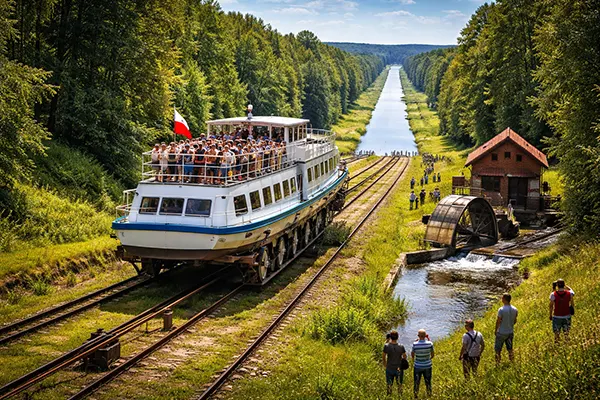
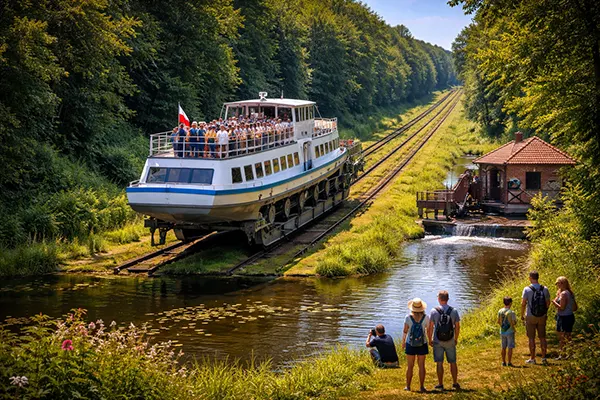
The most remarkable feature is its five inclined planes, where boats are placed onto rail-mounted platforms and pulled over land. This system is powered by water-driven turbines, meaning the canal still operates largely using its original technology. Such a solution was innovative for its time and remains rare even today, with only a few comparable systems worldwide.
From a tourism perspective, the canal offers more than just scenic views. It presents a functioning example of historical engineering, preserved and adapted for modern visitors. Travellers can observe the mechanisms in action, gaining insight into how transport challenges were solved before the widespread use of electricity and modern infrastructure.
How the Inclined Plane System Works
When a vessel approaches an inclined plane, it is guided onto a submerged carriage equipped with rails. Once secured, the carriage is slowly pulled out of the water and moves along a track over land. The process is steady and controlled, ensuring both safety and minimal stress on the structure of the boat.
The driving force behind this system is water power. Each inclined plane uses flowing water to turn turbines, which in turn operate the cable mechanism that pulls the carriage. This design eliminates the need for external energy sources and highlights the efficiency of 19th-century engineering solutions.
For visitors, watching this process is often the highlight of the journey. The transition from water to land and back again happens seamlessly, yet it feels entirely unconventional. It is precisely this contrast between simplicity and ingenuity that makes the canal memorable.
Planning a Visit to the Canal in 2026
The Elbląg Canal is accessible from several towns, including Elbląg and Ostróda. Regular tourist cruises operate between spring and early autumn, typically from May to September, depending on weather conditions. In 2026, updated schedules and booking options are available online, making it easier to plan a visit in advance.
Travellers can choose between short routes that include one or two inclined planes or longer journeys covering the full system. The extended routes can take several hours, offering a slower pace that allows time to appreciate both the engineering and the surrounding landscapes, including forests, wetlands, and small lakes.
It is advisable to book tickets ahead of time during peak months, as the canal remains a popular destination for both domestic and international visitors. Morning departures tend to be less crowded, while afternoon trips often provide better lighting conditions for photography.
Best Routes and Practical Tips
The most popular section runs between Buczyniec and Całuny, where visitors can experience multiple inclined planes in one journey. This route offers a concentrated view of the canal’s most distinctive features without requiring a full-day commitment.
For those interested in a more comprehensive experience, longer cruises between Ostróda and Elbląg provide a deeper understanding of the canal’s scale. These routes combine natural scenery with technical landmarks, making them suitable for travellers who prefer a detailed exploration.
Comfortable clothing and weather-appropriate gear are recommended, as much of the experience takes place outdoors. Even in summer, temperatures can vary, especially on the water. Bringing a camera or binoculars can also enhance the visit, particularly for observing wildlife in the surrounding areas.
Why the Canal Remains Relevant Today
Despite being over 160 years old, the Elbląg Canal continues to function using its original principles, which makes it a rare example of preserved industrial heritage. In 2026, it is recognised not only as a tourist attraction but also as an educational site, illustrating sustainable engineering long before the concept became widely discussed.
The canal has also been included in efforts to promote regional tourism in Poland. Its uniqueness helps diversify travel routes beyond major cities, encouraging visitors to explore lesser-known areas with historical significance. This aligns with broader trends in European tourism, where interest in local and authentic experiences continues to grow.
Additionally, ongoing conservation work ensures that the canal remains operational while maintaining its historical integrity. This balance between preservation and accessibility allows visitors to experience a working system rather than a static museum exhibit.
The Canal as a Cultural and Engineering Landmark
The Elbląg Canal is often compared to other engineering achievements of the 19th century, yet it stands apart due to its hybrid approach combining water transport and rail mechanisms. Its continued operation demonstrates the durability and adaptability of its original design.
From a cultural perspective, the canal represents a period of rapid industrial development in Central Europe. It reflects how infrastructure projects shaped regional economies and influenced settlement patterns, particularly in areas with challenging terrain.
For modern visitors, the canal offers more than a visual attraction. It provides context, showing how historical solutions can remain relevant and functional. This combination of practicality and heritage makes it a distinctive destination within Poland’s tourism landscape.
Popular articles
-
Elbląg Canal: How to See Boats Travelling Over Land in Poland
The Elbląg Canal remains one of the most unusual engineering …
-
 Przemyśl Fortress — One of the Largest Defensive Complexes in Europe
Przemyśl Fortress in south-eastern Poland remains one of the most …
-
 Silver Mountain Fortress (Srebrna Góra): The Largest Mountain Fortress...
Rising above the Owl Mountains in Lower Silesia, Silver Mountain …