

Przemyśl Fortress — One of the Largest Defensive Complexes in Europe
Przemyśl Fortress in south-eastern Poland remains one of the most remarkable military engineering projects of the late nineteenth and early twentieth centuries. Built by the Austro-Hungarian Empire, the fortress was designed to protect the empire’s eastern frontier and control strategic routes across the Carpathian region. Although much of the system was damaged during the First World War, dozens of forts, defensive structures, and military roads have survived. Today the complex attracts historians, researchers, and travellers interested in military heritage and long-distance hiking routes.
The Strategic Importance of Przemyśl in the Austro-Hungarian Empire
During the second half of the nineteenth century, the Austro-Hungarian Empire faced growing geopolitical tension along its eastern borders. The region around Przemyśl, located near the San River and close to present-day Ukraine, became a key defensive position between the Carpathian Mountains and the Galician plains. Military planners recognised that control over this corridor could determine the success of large-scale troop movements.
Construction of the fortress system began in the 1850s and expanded significantly after the 1870s. Engineers designed a ring of defensive structures surrounding the city, forming one of the largest fortress systems in Europe. At its peak, the complex included more than forty main forts, artillery batteries, supply depots, barracks, and fortified observation posts.
The fortress served both defensive and logistical roles. Railway connections and military roads allowed the rapid movement of soldiers and supplies. By the beginning of the First World War, Przemyśl Fortress had become the third largest fortified complex in Europe after Verdun and Antwerp, highlighting its importance within the imperial defence strategy.
The Fortress During the First World War
Przemyśl Fortress played a crucial role during the early stages of the First World War. In 1914 the complex became the centre of heavy fighting between Austro-Hungarian and Russian forces. The fortress endured two major sieges as Russian armies attempted to break through the defensive ring and advance toward Hungary.
The first siege ended in October 1914 when Austro-Hungarian forces managed to push Russian troops back temporarily. However, the second siege lasted several months and created extremely difficult conditions for the defenders. Shortages of food, ammunition, and medical supplies weakened the garrison as winter progressed.
In March 1915 the fortress command decided to destroy many of its defensive structures to prevent their capture intact. Shortly afterwards the remaining troops surrendered. Although the fortress was later recaptured by Austro-Hungarian and German forces, much of the infrastructure had already been damaged.
Architecture and Engineering of the Fortress System
The Przemyśl fortress complex represents a unique example of nineteenth-century military architecture. Engineers designed a multi-layered defence system consisting of outer and inner rings of forts positioned several kilometres apart. This configuration allowed artillery units to cover large areas while supporting neighbouring positions.
Most of the forts were constructed using brick, stone, and later reinforced concrete. Early designs followed traditional polygonal fortress principles, while later forts incorporated modern artillery protection techniques developed in response to more powerful weapons. Underground corridors, armoured observation posts, and protective earth embankments were common features.
The forts were connected by military roads and communication lines that allowed efficient coordination between different sections of the defensive ring. Observation towers and signal stations enabled commanders to monitor enemy movements across the surrounding landscape.
Types of Forts Within the Przemyśl System
The fortress complex included several categories of defensive structures, each designed for a specific military role. Large artillery forts served as the primary defensive positions and were equipped with heavy guns capable of firing over long distances.
Supporting infantry forts were positioned between major artillery installations. These smaller structures protected vulnerable gaps in the defensive line and provided shelter for infantry units responsible for close-range defence. Many of them were partially hidden within forested terrain to reduce visibility.
Additional structures included observation posts, ammunition depots, and fortified shelters for troops. Together these elements created an integrated defensive system designed to delay or halt large-scale enemy advances toward the Carpathian passes.
Przemyśl Fortress Today: Historical Routes and Tourism
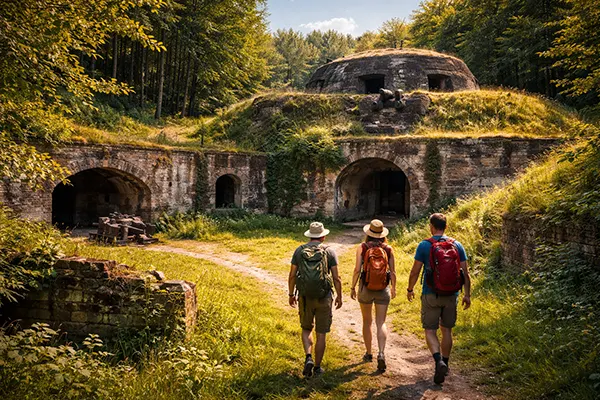
Despite the destruction that occurred during the First World War, a large number of Przemyśl forts remain visible today. Some structures have been partially restored, while others survive as atmospheric ruins surrounded by forests and hills. This combination of history and landscape has turned the area into a unique destination for cultural tourism.
Several historical routes now connect the surviving forts around the city. These routes are used by hikers, cyclists, and history enthusiasts who want to explore the scale of the former defensive system. Information boards and local museums help visitors understand how the fortress operated during its military period.
The most accessible forts include Fort Borek, Fort Salis-Soglio, and Fort Werner. These locations provide clear examples of Austro-Hungarian military architecture and offer panoramic views over the surrounding countryside.
Recommended Routes for Travellers
One of the most popular ways to explore the fortress system is the Przemyśl Fortress Cultural Route. This marked trail connects multiple forts and historical locations around the city and can be completed in sections depending on the visitor’s available time.
Cycling routes have also become increasingly popular in recent years. The terrain surrounding the fortress includes forest paths and rural roads that allow travellers to visit several forts within a single day while enjoying the natural landscape of the Subcarpathian region.
Guided historical tours are available through local museums and heritage organisations. These tours provide detailed explanations of the fortress construction, wartime events, and the daily life of soldiers who served within the defensive system more than a century ago.
Popular articles
-
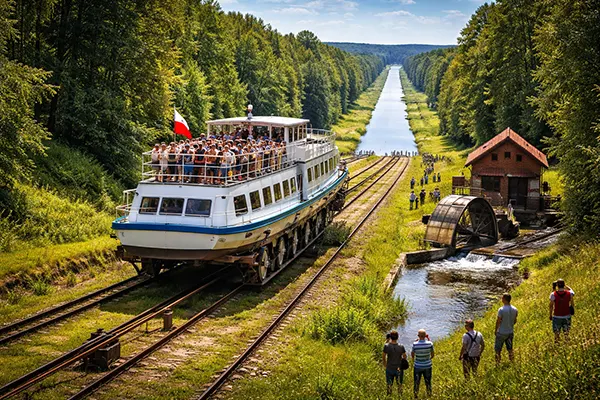 Elbląg Canal: How to See Boats Travelling Over Land in Poland
The Elbląg Canal remains one of the most unusual engineering …
-
Przemyśl Fortress — One of the Largest Defensive Complexes in Europe
Przemyśl Fortress in south-eastern Poland remains one of the most …
-
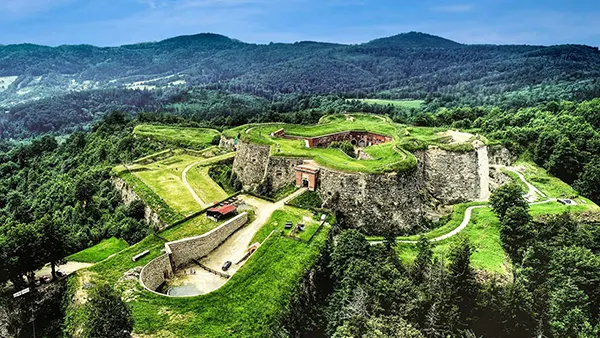 Silver Mountain Fortress (Srebrna Góra): The Largest Mountain Fortress...
Rising above the Owl Mountains in Lower Silesia, Silver Mountain …