
Kwidzyn Gothic Castle Closed for Restoration: What Will Change by 2030?
Kwidzyn Castle, one of northern Poland’s most distinctive Gothic landmarks, closed to visitors in September 2026 for an extensive restoration programme worth more than PLN 64 million. The medieval residence of the Pomesanian cathedral chapter will remain inaccessible while its historic walls, interiors and visitor facilities undergo major improvements. The project also includes five new permanent exhibitions, additional museum space and a separate attraction devoted to the history of Kwidzyn. Construction and conservation work is scheduled for 2026–2029, with the castle expected to welcome visitors again in 2030. For travellers considering a visit to the Pomeranian region, the closure changes sightseeing plans for several years, but it also marks an important investment in the preservation of this remarkable medieval monument.
Why Kwidzyn Castle Closed in September 2026
The decision to close Kwidzyn Castle followed the approval of a comprehensive conservation project prepared by the Malbork Castle Museum, which administers the historic property. On 13 April 2026, Poland’s Ministry of Culture and National Heritage announced that the museum had secured support through the European Funds for Infrastructure, Climate and Environment programme, known as FEnIKS. The investment was formally presented at a press conference on 26 June 2026. Museum representatives confirmed that the project would involve the entire castle rather than a limited renovation of individual rooms. The monument remained open throughout August before closing at the beginning of September, allowing preparations for construction and conservation work to proceed without the presence of tourists.
The restoration is necessary because several parts of the medieval building require substantial attention. Moisture affecting the brickwork, particularly in lower sections of the structure, has been identified as a significant conservation concern. Ageing installations, deteriorating doors and windows, and the condition of historic interior surfaces have also contributed to the need for extensive repairs. These issues are especially important in a Gothic building constructed from brick, where prolonged exposure to damp conditions can gradually damage masonry and historic finishes. Rather than carrying out isolated repairs, the museum intends to address structural conservation, building services and the future use of the interior as part of one coordinated programme.
The project’s total value is PLN 64,173,906.13, according to figures published by the Malbork Castle Museum. Of this amount, approximately PLN 41.46 million comes from the European FEnIKS programme, while the Polish state budget contributes approximately PLN 10.69 million. The remaining funding includes resources allocated by the museum. The investment covers the castle itself, neighbouring premises intended for exhibitions and improvements to surrounding green areas. Although the construction programme is scheduled to finish by the end of 2029, the announced reopening date is 2030. Visitors should therefore treat 2030 as the planned return of normal museum access, rather than assuming that completion of construction will immediately mean the doors are open.
What Makes the Medieval Castle Worth Preserving?
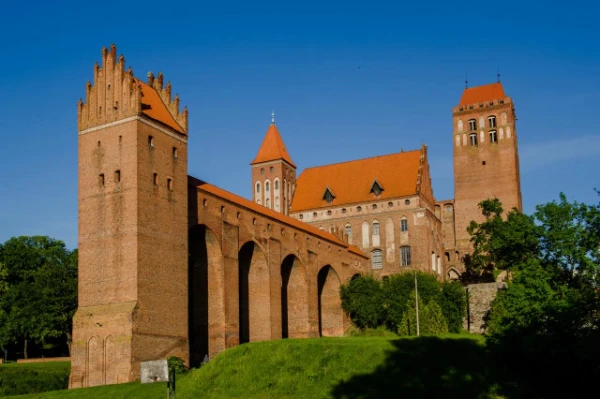
Kwidzyn Castle was built during the fourteenth century as the residence of the Pomesanian cathedral chapter, a community of canons responsible for important religious and administrative duties. Unlike many fortifications associated directly with the Teutonic Order, the castle served an ecclesiastical institution, although its architecture reflects the defensive traditions of medieval Prussia. Together with the neighbouring cathedral, it forms an imposing Gothic complex overlooking the surrounding town and the Lower Vistula region. Its red-brick walls, towers, courtyard and historic passageways illustrate how religious authority, residential life and fortification could be combined within a single medieval establishment.
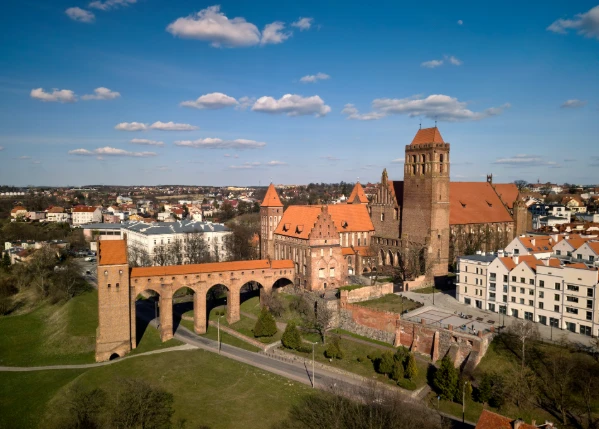
The castle’s most recognisable architectural feature is its remarkable dansker, or gdanisko, a medieval sanitary tower connected to the main building by a covered arcade approximately 55 metres long. The elevated passage leads towards a separate tower positioned away from the principal residential quarters. This arrangement allowed sanitary facilities to be located outside the main building while remaining accessible from within the fortified complex. The extraordinary length of the passage makes the structure particularly distinctive among surviving Gothic castles in Poland. It is also one of the features that visitors most readily associate with Kwidzyn, appearing prominently in photographs of the medieval town.
The historical importance of the castle extends beyond its architecture. Over the centuries, the complex experienced changes in political control, institutional use and interior arrangements, leaving traces of different periods within the surviving structure. Its association with the Pomesanian cathedral chapter provides an opportunity to examine a less familiar aspect of the medieval history of northern Poland. The current restoration is therefore intended not simply to maintain an attractive historic building, but to protect evidence of centuries of religious, social and regional development. By improving the condition of the rooms and making previously unused areas suitable for exhibitions, the museum expects to present more of this history directly to visitors.
What Will Change Inside Kwidzyn Castle by 2030?
The planned work covers every storey of the castle, including rooms that have not previously been used for regular exhibitions. Conservation will address historic interiors and the external structure, with attention to the condition of masonry, architectural details and installations essential to the safe operation of the museum. Bringing unused spaces into service is an important part of the programme because it will allow the museum to expand its exhibitions without constructing a completely separate building within the historic complex. The intention is to preserve the medieval character of the castle while creating conditions better suited to protecting collections and accommodating visitors.
The museum’s future exhibition programme will be considerably broader than a conventional presentation of medieval castle history. Five permanent exhibitions are planned, covering archaeology, natural history, regional traditions, the Pomesanian cathedral chapter and historic noble families. These subjects were identified by the Ministry of Culture and National Heritage when the investment was announced in June 2026. Their inclusion means that the restored castle should provide a more extensive account of the communities that inhabited the Lower Vistula region over thousands of years. The different exhibitions will also give visitors a clearer connection between the castle, its surrounding landscape and the wider historical development of Pomerania.
Improvements to visitor facilities are also included in the investment. The project provides for additional equipment and supporting infrastructure needed to operate the renovated museum spaces, alongside changes intended to make cultural activities more accessible. The Ministry has also identified the revitalisation of neighbouring green areas as part of the approved undertaking. However, detailed arrangements for future visitor routes, ticket categories and individual accessibility features have not yet been confirmed in the official information available in 2026. These practical matters will become particularly important closer to reopening, when the museum can explain how visitors will move through the restored building and which facilities will be available.
Five New Permanent Exhibitions and a City History Museum
The first proposed exhibition will examine Palaeolithic life, including hunter-gatherer communities and the period before settled agriculture. A second will concentrate on the Wielbark culture, an important archaeological culture associated with parts of present-day Poland during the Roman period. A third exhibition will focus on the ethnography of the Lower Vistula region, presenting the traditions and cultural heritage of its communities. Together, these displays will take visitors far beyond the castle’s medieval origins. They are intended to explain how people lived in this area long before the Gothic residence was constructed, helping establish a broader historical context for the development of Kwidzyn and its surroundings.
The remaining two exhibitions will explore subjects more directly connected with the castle’s historical identity and the society of later centuries. One will be devoted to the Pomesanian cathedral chapter, explaining the role of the canons who originally occupied the residence and the institution to which they belonged. Another will address historic noble families, their lifestyles, heraldry and their place in the region’s early modern history. These displays should help visitors understand the relationships between religious institutions, landownership and social status. Rather than treating the building as an isolated monument, the new exhibitions will connect its architectural features with the people and institutions that influenced the surrounding region.
A separate permanent exhibition entitled “Taki oto Kwidzyn”, which can be translated as “Such Is Kwidzyn”, is planned for premises at 1 Kruka Street, close to the castle. This part of the project will present important episodes from the town’s history and include a new tourist information point with a museum shop. Unlike the main castle, which is scheduled to reopen in 2030, this exhibition is expected to open in 2027, according to the museum’s published visitor information. The earlier opening should provide an additional cultural attraction while restoration continues. It is important, however, to distinguish the two locations: the planned opening of the Kruka Street exhibition does not mean that visitors will regain access to the castle interiors in 2027.
Visiting Kwidzyn During the Restoration: Dates and Alternatives
As of November 2026, Kwidzyn Castle is officially closed to visitors, and the Malbork Castle Museum’s booking information confirms that comprehensive construction and conservation work is under way. There are no regular castle tours or public exhibition opening hours during this closure. Travellers planning a journey specifically to see the medieval interiors, courtyard or historic passageways should not rely on old travel guides or previously published ticket information. The museum’s current schedule identifies 2030 as the intended reopening year, but does not provide a precise reopening day. The safest approach is to consult the official Malbork Castle Museum website before arranging a future visit, particularly because conservation schedules can change as work progresses.
Kwidzyn itself remains a destination of historical interest even while its principal medieval monument is undergoing restoration. The castle and cathedral complex continues to form an important part of the town’s architectural identity, although access to the immediate construction area may be restricted. Visitors should respect temporary barriers and avoid assuming that former viewpoints or paths remain accessible. The town’s historic streets and public spaces can still form part of a visit, subject to local conditions. From 2027, the planned exhibition at Kruka Street should provide another reason to spend time in Kwidzyn, particularly for travellers interested in the relationship between the modern town and its medieval past.
For tourists who want to visit a Gothic castle rather than postpone their trip until 2030, two nearby destinations deserve consideration: Malbork and Sztum. Both are associated with the Malbork Castle Museum and remain open under their published seasonal arrangements. Malbork is especially suitable for a full-day visit because of the size of its medieval castle complex and the range of historical interiors and exhibitions. Sztum offers a smaller historic castle with a different atmosphere and a more compact sightseeing experience. The three towns can form part of a wider journey through northern Poland’s Gothic heritage, although Kwidzyn’s castle should currently be regarded as a closed monument rather than an available museum attraction.
What Visitors Should Know Before Planning a Trip
Malbork Castle is the most substantial alternative for travellers interested in medieval architecture. Its UNESCO-listed complex is considerably larger than Kwidzyn Castle and contains important examples of Gothic construction, defensive architecture and historic residential spaces. For the autumn and winter season running from 1 October 2026 to 25 April 2027, the museum advertises a historical route from Tuesday to Sunday between 09:00 and 16:00, with the last admission at 12:45. A shorter grounds route is available under separate admission arrangements, and Mondays are designated for free access to that route. Because entry times differ between the routes, booking the correct option is particularly important when planning a day trip.
Sztum Castle provides another practical possibility and lies closer to Kwidzyn than Malbork. During the same autumn and winter season, the Sztum branch advertises opening hours from Tuesday to Sunday, 09:00–15:00, with final admission at 14:00. On Mondays, the museum interiors are closed, although the courtyard is accessible between 09:00 and 15:00. Tuesday is normally the free-admission day, with visitors required to collect a ticket. These arrangements make Sztum a useful option for a shorter castle visit, especially when combined with time in Kwidzyn. Travellers should nevertheless check the current timetable before departure, since seasonal adjustments, public holidays and special events can affect access.
The restoration programme is expected to transform Kwidzyn Castle into a more substantial regional museum while safeguarding its medieval architecture for future generations. The main milestones are already clear: closure in September 2026, work continuing through 2029, the planned Kruka Street exhibition in 2027 and the castle’s anticipated reopening in 2030. What remains uncertain is the exact date on which visitors will be able to enter the restored interiors and how the completed sightseeing routes will operate. Until these details are announced, the most reliable sources are the official websites of the Malbork Castle Museum and Poland’s Ministry of Culture and National Heritage. For anyone travelling through Pomerania before 2030, knowing the difference between the castle’s closure and the opening of its neighbouring exhibition will help avoid disappointment and make it easier to plan a worthwhile visit.
Popular articles
-
Kwidzyn Gothic Castle Closed for Restoration: What Will Change by 2030?
Kwidzyn Castle, one of northern Poland’s most distinctive Gothic landmarks, …
-
 Krasiczyn Castle: Four Towers, Sgraffito and the History of One of Pol...
Krasiczyn Castle stands in south-eastern Poland, in the village of …
-
 Discovering the Sights of Aarhus: A Blend of History, Culture, and Nature
Aarhus, Denmark’s vibrant second city, offers a charming mix of …